
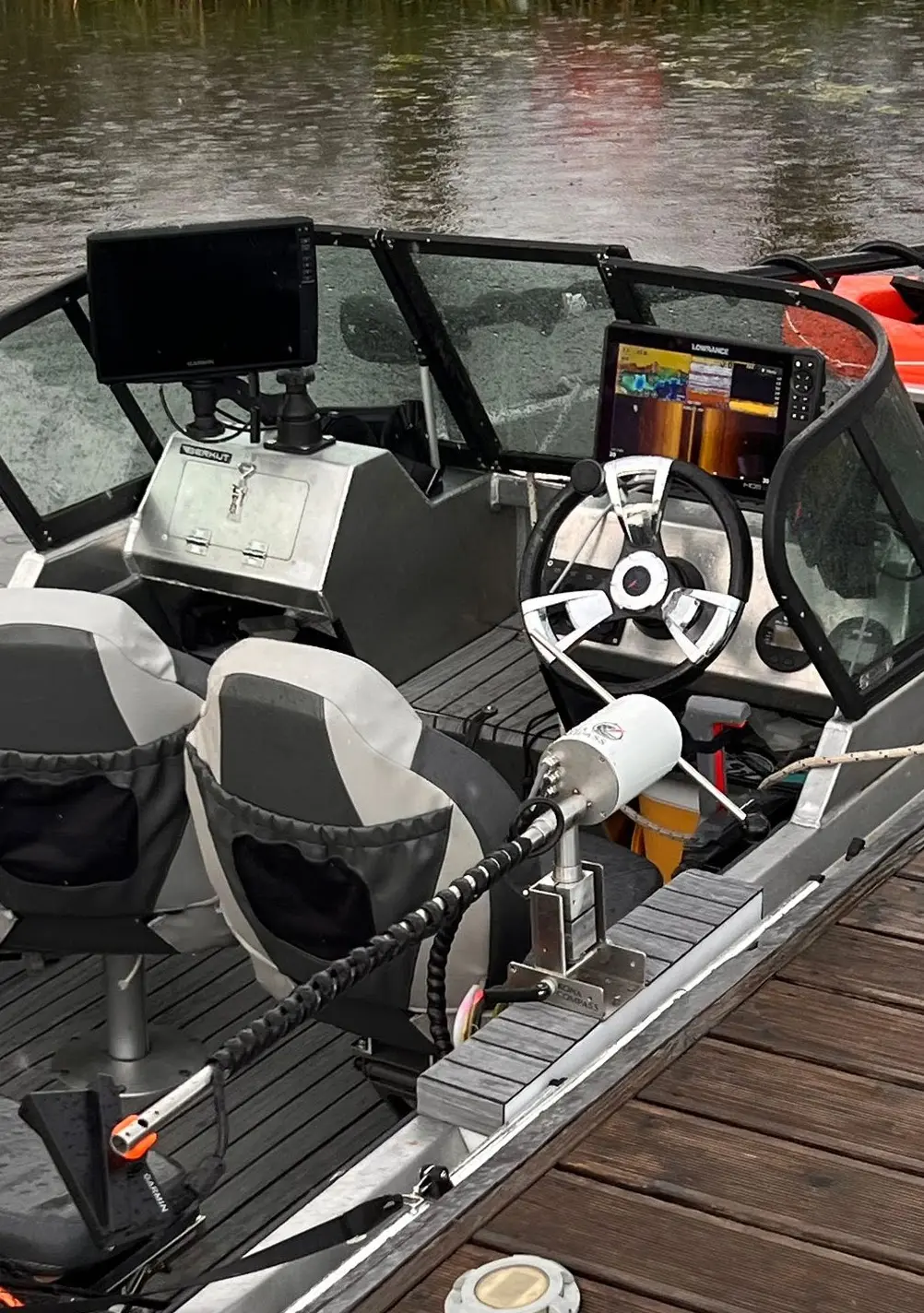
The setup most anglers start with
A manual transducer pole — RAM mount, Traxstech, or a DIY build — is where most live sonar setups begin. It is inexpensive, requires no power, works with any sonar brand, and fits on almost any boat. For many anglers fishing calm water from a stationary position, it is enough.
The limitations become visible as soon as conditions change: current moves the boat, wind rotates the hull, the trolling motor kicks in. The transducer follows the forces acting on it, and the angler follows the transducer. Manual correction becomes a parallel activity to fishing.
Reaction time: manual vs motorized
The fundamental difference between manual and motorized control is where the control loop closes. With a manual pole, the loop is: angler sees drift on screen → angler reaches for the pole → angler corrects → drift resumes. The loop closes through the angler’s body.
With a motorized rotator running heading hold, the loop is: orientation sensor detects heading deviation → motor corrects → heading restored. The loop closes in milliseconds, before the drift is visible on screen. The angler is outside the loop entirely.
Precision: what heading hold changes
Manual correction is approximate. When you reach for the pole and re-aim the transducer, you are aiming by feel — there is no reference to a known heading, no repeatability. You aim at what looks right on screen.
Heading hold uses an integrated orientation sensor to maintain a precise compass heading. If you set the transducer to 047°, the system holds 047°. When you re-engage after repositioning the boat, it returns to the same heading. Manual control cannot replicate this.
For targeting specific structure — a dock piling, a brush pile edge, a channel ledge — repeatable positioning is the difference between a useful sonar image and a shifting one.
The comparison: manual pole vs motorized rotator
When manual is still the right answer
Manual control is not obsolete. For anglers who:
- Fish primarily from an anchored or staked-out position in calm water
- Do not fish in current or conditions that cause regular drift
- Are running a simple setup without trolling motor or pedal control
- Are just getting started with live sonar and learning the basics
...a manual pole is a sensible and cost-effective choice. The limitation only becomes a performance constraint when conditions or fishing style demand more.
When motorized control changes outcomes
The upgrade is most impactful for anglers who:
- Fish current regularly — rivers, tidal zones, points with flow. Manual correction in current is continuous; heading hold eliminates it.
- Fish from a moving platform — drift fishing, trolling, or repositioning frequently. The transducer stays on heading while the boat moves.
- Fish tournaments — where attention is a performance variable. Every second spent on transducer correction is a second not reading the sonar.
- Target specific structure — precise, repeatable heading positioning is not achievable with a manual pole.
- Fish solo — no co-angler to handle the sonar. Foot pedal and wireless remote make single-handed operation practical.
Auto search: a mode with no manual equivalent
One capability of motorized rotators has no manual analogue: auto search. In this mode, the rotator sweeps a configurable sector — say, 120° — automatically, without any input from the angler.
For search fishing — working a flat, covering a long point, checking around structure — auto search replaces the continuous manual sweep that would otherwise require constant pedal or hand input. The transducer covers water; the angler watches the screen.
The sector angle is adjustable: narrow for tight coverage of a specific area, wide for open-water search. This is not a feature that can be replicated with a manual pole regardless of angler effort.
Does the trolling motor matter?
Some motorized solutions integrate directly with the trolling motor — LiveScanner, for example, syncs rotation with motor heading. This is elegant but adds a hard dependency: you need a compatible trolling motor, and the system does not work independently.
Kona Compass is a standalone rotator. It runs on a standard marine electrical connection, mounts independently, and works with any trolling motor or no trolling motor at all. The heading hold is derived from the rotator’s own orientation sensor, not from motor feedback.
For anglers who want to keep their trolling motor choice independent from their sonar control, standalone mounting is the more flexible architecture.