
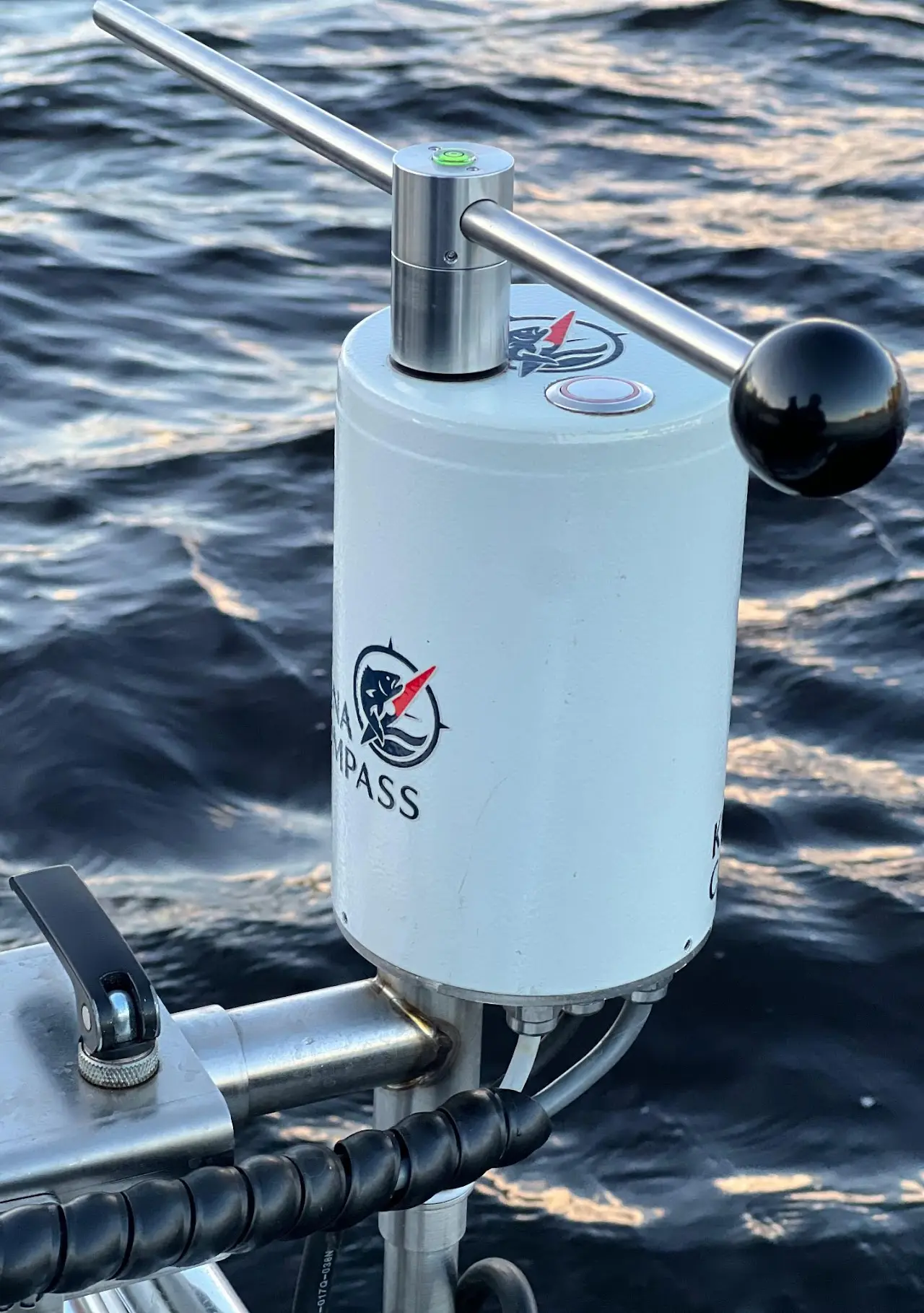
The problem every live sonar angler knows
You set up on a flat, dial in your Garmin Panoptix LiveScope, and find fish holding near a brush pile. You make a cast — and by the time you look back at the screen, the transducer has rotated 40 degrees. The fish are gone from the image. You reach down, correct the direction manually, and repeat. Every drift. Every cast. Every turn of the boat.
This is not a LiveScope problem. It is not an ActiveTarget problem. It is a mounting problem — and it affects every live sonar system equally.
Why manual mounts cannot hold direction
A manual transducer pole or bracket is a passive mount. It holds whatever position you physically set it to — nothing more. There is no sensor reading heading, no motor correcting drift, no mechanism responding to external forces.
When current pushes against the transducer housing, the mount offers no resistance. When you spin the trolling motor to reposition the boat, the transducer rotates with the force. When a wake rocks the hull, the transducer moves.
The result: the live sonar is pointing in the right direction for roughly 20% of the time you are fishing. The rest is correction.
What heading hold actually does
A motorized transducer rotator with heading hold uses an integrated orientation sensor — essentially a compass — to know which direction the transducer is pointing at all times. When you set a heading, the system continuously compares the current heading to the target heading and fires the motor to correct any deviation.
The correction is not reactive in the way manual correction is. It happens in real time, before drift becomes visible on screen. The transducer stays on target regardless of current, wind, or boat movement.
The practical effect: you set a direction once and it holds. You can make casts, reposition the boat, fight a fish — the transducer tracks the set heading throughout.
Direction Hold vs Direction Lock — what is the difference?
These are two distinct operating modes that serve different fishing scenarios:
Most anglers use Direction Hold the majority of the time — it handles current and drift automatically. Direction Lock is the precision tool for specific scenarios.
Does this work with Garmin Panoptix LiveScope, Lowrance ActiveTarget, and Humminbird MEGA Live?
Yes — a motorized rotator mounts between your transducer bracket and the transducer itself. It is mechanically and electrically independent from the sonar system. It does not communicate with the sonar unit; it simply controls transducer direction.
Kona Compass is compatible with:
- Garmin Panoptix LiveScope — LVS32, LVS34, LVS34-IF
- Lowrance ActiveTarget — ActiveTarget, ActiveTarget 2, ActiveTarget 2 XL
- Humminbird MEGA Live Imaging
Compatibility is not brand-locked. If you switch sonar systems, the rotator stays on the boat.
Manual correction: the hidden cost
The cost of manual transducer correction is not just the few seconds per drift event. It is cumulative attention drain across an entire fishing session.
Every time you reach for the pole, you look away from the water. Every correction takes your hand off the rod. In tournament fishing, where a window of opportunity can last seconds, that cost is measurable.
Heading hold does not make you a better angler. It removes a task that should not require your attention at all — and returns that attention to the water.
What to look for in a motorized transducer rotator
Not all motorized rotators are equal. When evaluating options, the critical factors are:
- Integrated orientation system — heading hold only works if the device has its own compass or IMU. A rotator without one cannot hold heading; it can only respond to manual input.
- Cross-brand compatibility — brand-locked systems require replacement if you change sonar.
- Included controls — wireless remote and foot pedal allow control without reaching over the side. These should come in the box, not as add-ons.
- Marine-grade construction — saltwater, spray, and UV exposure are constant. Stainless steel throughout eliminates galvanic corrosion risk.
- Maintenance requirements — sealed, composite-bearing systems require no greasing or regular service.